
Case 16 of the 2017.2 RACGP KFP: Sally is a 23 year old female who presents with cough, back pain and fever after returning from Bali 3 days prior. There are no bowel or urinary symptoms. She has no past medical history of note. She had malaria prophylaxis of Doxycycline 100mg daily but did not have time to complete any travel vaccinations and has the standard Australian childhood vaccinations.
What are the key features of the travel history to elicit in this case? (list 8)
- Locations visited.
- Length of stay.
- Exposure to mosquitos.
- Exposure to freshwater.
- Sexual contacts.
- Exposure to animals.
- Exposure to illicit drugs
- Compliance with malaria prophylaxis
What are the differentials of this presentation? (list 7)
- Dengue
- Chikungunya
- Influenza
- Typhoid
- Pneumonia
- Hepatitis A
- Malaria
Whilst malaria is less likely if she was compliant with her prophyalxis, no prophylaxis is 100% effective.
There are no marks given for UTI/gastroenteritis as this is ruled out in the stem.
From RCH Clinical Practice Guidelines on Fevers in The Returned Traveller
| Malaria | P.falciparum | 7 days (minimum) to 12 weeks (usual maximum) |
| Other Plasm.species. | Weeks to several years | |
| Measles | 7 – 18 days | |
| Dengue | 3 – 14 days | |
| Hepatitis A | 14 – 50 days | |
| Hepatitis B | 45 – 180 days | |
| Typhoid | 3 days – 3 mths | |
| Campylobacter | 1 – 10 days | |
| Shigella | 12 hrs – 4 days | |
| Viral hemorrhagic fevers | 2 – 21 days | |
| Influenza |
|
|
Sally then shows you some itchy finger lesions that she is concerned about.
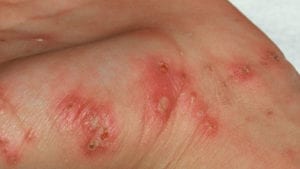
What is the pharmacological management of this presentation? (List 2 different options) (drug name, dose, duration, frequency)
- permethrin 5% cream topically to dry skin from the neck down, Leave on for a minimum of 8 hours and reapply to hands if washed. Repeat treatment in 7 day
- benzyl benzoate 25% emulsion topically to dry skin from the neck down, paying particular attention to hands and genitalia. Leave on for 24 hours and reapply to hands if washed. Repeat treatment in 7 days.
References:
https://www.nps.org.au/australian-prescriber/articles/assessing-fever-in-the-returned-traveller
https://www.aafp.org/afp/2013/1015/p524.html
RACGP Feedback – Case 16
This case focused on a female patient returning from overseas travel to south-east Asia who developed cough, back pain and fever in the few days following her return. The case scenario contained information on her pre-travel preparations, as well as malaria prophylaxis. This information is relevant while responding to the questions. Candidates were required to identify possible differential diagnoses and history other than that contained in the scenario in order to assess the patient’s symptoms.
The most common errors were the failure to hypothesise appropriate differential diagnoses given the pattern of presentation, and to ask about aspects of history that were irrelevant, such as PR bleeding, given that the stem clearly indicated that there were no bowel or urinary symptoms. In the case scenarios within the KFP exam, it is common to state that there is no past medical history of note.
Consequently, any answers exploring a history of previous illnesses or, for example, enquiring about a history of asthma will not score marks. This was a common issue across the whole KFP exam paper. The final question in the case presented a clinical description, as well as a photograph of scabies, with candidates required to give specific management.
RACGP Conclusion on Technique
As outlined above, there are some common themes and key issues to consider when approaching the KFP exam:
- The KFP exam is not a simple short-answer paper. You must answer the question in the context of the clinical scenario provided, utilising all of the information provided. Read the scenario at least twice.
- Keep your answers succinct.
- Only provide the number of answers requested. Review your answer – have you created a list rather than one answer per line? If so, you will be penalised for extra answers.
- Always read the question at least twice and, after you answer, check that you have answered the actual question asked.
- Be specific in your answers, whether in the investigations being ordered or the treatment you are prescribing. Non-specific answers will not score or will attract a much lower score.
- General answers such as ‘educate’, ‘refer’, ‘reassure’ or ‘review’ do not score without specific detail. For example, providing a review timeline and details about the specialist to whom you are referring (along with degree if urgency, if appropriate) may score marks if relevant to the scenario and question.
- Be aware of clinical guidelines and any important changes or additions to treatments. If guidelines change very close to the exam, the marking keys are adapted to consider the original and the new guidelines so candidates are not penalised if they have not seen a guide published close to the exam sitting.
- Access the practice exams provided after enrolment closes and utilise the RACGP assessment resources provided for candidates.
References
- https://www.nps.org.au/australian-prescriber/articles/assessing-fever-in-the-returned-traveller
- https://www.rch.org.au/clinicalguide/guideline_index/Illness_in_the_returned_traveller/
- https://www.racgp.org.au/afp/2012/november/rash-in-the-returned-traveller/
- https://www.mja.com.au/journal/2002/177/4/9-infections-returned-traveller
- https://wwwnc.cdc.gov/travel/yellowbook/2018/post-travel-evaluation/fever-in-returned-travelers
- https://cdn.onthewards.org/wp-content/uploads/2017/04/Febrile-returned-traveller-with-Indy-Sandaradura-final.pdf
- https://ama.com.au/sites/default/files/documents/20131108_measles_in_returned_travellers_clinicians.pdf
- https://www.mja.com.au/system/files/issues/177_04_190802/loo10413_fm.pdf
- https://www.aafp.org/afp/2003/1001/p1343.html
- https://patient.info/doctor/diagnosing-the-tropical-traveller
- https://patient.info/health/typhoid-and-paratyphoid-fever-leaflet
- https://www.ncbi.nlm.nih.gov/pubmed/15151589


