
Julie, a 29 year old women presents to you with a pain in the back of her leg which came on whilst playing touch football 1 week ago. She wasn’t going to play this game as she has been fighting a sore throat for the past 2 weeks and is generally more fatigued especially over the past 3 months due to chronic diarrhoea and lower abdominal pain which she assumed would clear eventually.
This hamstring pain has happened once before at the end of the season last year, but resolved over 4 weeks. She is strictly compliant with levlen ED and takes paracetamol 1g qid prn. Whilst you are examining her legs you notice some red lumps on her shins as shown in picture 1.
Picture 1
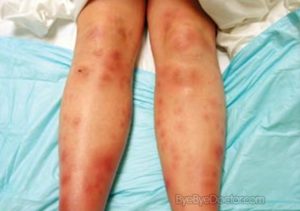
What are the predisposing factors for sustaining the hamstring injury? List 3
- Deconditioning
- High intensity exercise
- Obesity
RACGP – This case presented a 29 year old female with a classic hamstring injury and the predisposing factors increasing the risk of this injury.
GPCC – this should be free marks.
What is the single most likely diagnosis?
- Erythema Nodosum
GPCC – A case of erythema nodosum also appeared in KFP 2017.2. This case in particular is high yield on exams despite its relative and absolute scarcity in real practice. Tell me how this is representative of BEACH and I’ll eat my hat.
RACGP – Good answers were concise and specific, despite asking for a single ‘most likely’ diagnosis, some candidates provided two diagnosis, often with conflicting answers and many used ‘or’ between their answers. As discussed previously this will attract penalties and highlights the need to review answers to ensure the correct number of responses is given.
What are the most likely causes of these lesions? List 5
- Inflammatory Bowel Disease
- Gastrointestinal salmonella infection
- Giardia
- Oral contraceptive pill
- Streptococcal throat infection
- EBV infection
[Other variations of the above would be acceptable. Pregnancy is a cause of EN but as she is on the COCP this is unlikely, though in real life this should be excluded with a pregnancy test. Remember this is an exam, not real life, read the question – “most likely causes”]
NB – Although Crohn’s disease and ulcerative colitis can occur at any age, people are more frequently diagnosed between the ages of 15 and 35.
RACGP – The final of this case required candidates to correctly identify a classic presentation/appearance of erythema nodosum and then offer the most likely causes of this in the given clinical scenario; again not just a list of all causes but targeted to the patient in this case. The question did not ask for the diagnosis but required candidates to assess the photograph and history and then concisely list the most likely causes.
RACGP Feedback
This case presented a 29 year old female with a classic hamstring injury and the predisposing factors increasing the risk of this injury. The final part to the case presented an incidental finding on the patients shin and required candidates to consider the possible causes of the lesions in this patient.
Good answers were concise and specific, despite asking for a single ‘most likely’ diagnosis, some candidates provided two diagnosis, often with conflicting answers and many used ‘or’ between their answers. As discussed previously this will attract penalties and highlights the need to review answers to ensure the correct number of responses is given.
The final of this case required candidates to correctly identify a classic presentation/appearance of erythema nodosum and then offer the most likely causes of this in the given clinical scenario; again not just a list of all causes but targeted to the patient in this case. The question did not ask for the diagnosis but required candidates to assess the photograph and history and then concisely list the most likely causes.
GPCC Feedback
A case with erythema nodosum also appeared in KFP 2017.2.2.


