
Zacaria is a 60 year old man with long standing redness and scaling of the eye lid margins, which has come and gone over the years, accompanied by red eyes, with gritty foreign body sensation and he notices his lashes have been falling out. He has a history of seborrhoeic dermatitis.
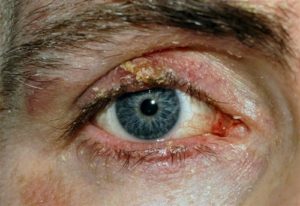
What is your primary diagnosis with this presentation? (1)
What are the differentials of this presentation? (3)
- Tumours of the eyelid margin
- Basal cell carcinoma (BCC)
- Squamous cell carcinoma (SCC)
- Sebaceous gland carcinoma.
- Contact dermatitis
- Atopic dermatitis
- Impetigo
- Cellulitis
- Conjunctivitis
- Contact lens problems
- Dry eye syndrome
What are the causes of this presentation (3)
- Meibomian gland dysfunction
- Certain medications such as antihistamines and HRT
- Allergies (contact lens solution, makeup, certain eye drops or ointments)
- Acne rosacea
- Lash mites
- Seborrheic dermatitis
- Menopause
- Pregnancy
- Bacterial infection
What are the key features of history in this presentation? (5)
- Redness of the eyelid margins
- Soft scaling of the eyelid margins
- Skin scales at the base of the eyelashes
- Greasiness of eyelids
- Meibomian capping
- Seborrhoea
- Foamy tear film
- Lashes stuck together
- Associated seborrhoeic dermatitis
- Red eyes
- Itchy eyes
- Gritty eyes
- Waxes and wanes
What are the KEY FEATURES OF HISTORY in Dry Eye, an associated condition? (3)
What are the KEY FEATURES OF HISTORY in Seb Derm, an associated condition? (2)
What are the KEY FEATURES OF HISTORY in Rosacea, an associated condition? (3)
What are the KEY FEATURES OF HISTORY in Anterior Staph Blepharitis? (3)
- Eyelid Hyperaemia
- Telangiectasia around lid margin,
- Crusting around base of lashes (= collarettes).
- Eyelash deformity
- Eyelash depigmentation
- Eyelash loss
- Inflamed Lid Skin
- Hard scales
- Inflammation around the meibomian gland orifices
- capping of the meibomian gland orifices
What are the key features of history in posterior blepharitis? (3)
- Meibomian gland orifices covered with oil globules or foam.
- Meibomian Glands dilated
- Meibomian Glands visibly obstructed
- Eyelid telangiectasia
- Eye lid scarring
- Chalazia
What are the key investigations in blepharitis? (3)
- Diagnosis normally on exam
- Slit lamp examination if severe or resistant
- Swabbing if severe or recurrent
- Biopsy if malignancy suspected
What are the key features of management of blepharitis? (5)
- Avoid contacts lenses
- Patient education
- Education about self-care
- Lid hygiene twice a day in acute phase
- Lid hygiene once daily at other times
- Manage infection
- No dependence on antibiotics
- Topical antibiotics if staph flare up
- Systemic antibiotics if no response to topical e.e. tetracycline
- Manage dry eye with artificial tear
- Manage inflammation with topical corticosteroids
- Manage underlying condition
What are the components of lid hygiene? (3)
What are the contraindications to tetracycline use? (3)
What are the complications of tetracyclines? (3)
- Teratogenesis in pregnancy
- Photosensitivity
- GI Disturbance
- Benign Intracranial Hypertension
- Vulvovaginal Candidiasis
What are the complications of blepharitis? (3)
- Chalazion
- Stye
- Trichiasis (inward-turning of eyelashes)
- Madarosis (loss of eyelashes)
- Poliosis (loss of pigment from eyelashes)
- Lid scarring and ulceration
- Dry eye syndrome
- Conjunctivitis
- Conjunctival cysts
- Keratitis
References
- patient.info
- Murtaghs
- Colour Atlas of Family Medicine
- Dynamed


