
In this article we briefly discuss the anti-arrhythmic classes and give examples of each type. This would come into play as a KFP or an OSCE question when faced with a case involving palpitations. or after diagnosing a specific arrhythmia.
What are the four classes of anti-arrhythmic medications?
[bg_collapse view=”button-blue” color=”#4a4949″ icon=”eye” expand_text=”Answer” collapse_text=”Show Less” ]
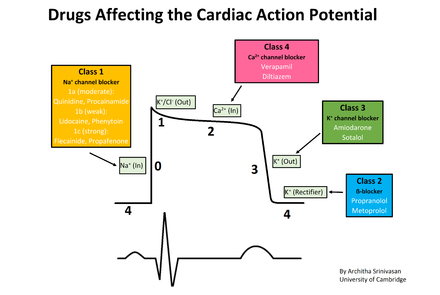 Class I Antiarrhythmics – Fast Sodium (Na) Channel blockers, they suppress phase 0
Class II Antiarrhythmics (Beta Blockers) Decrease slope of phase 4
Class III Antiarrhythmics Potassium Channel Blockers (Prolong Phase 3)
Class IV Antiarrhythmics Slow Calcium (Ca) channel blockers (Phase 2)
[/bg_collapse]
____________________________________________________________________________________________________________________________
Class I Antiarrhythmics – What phase of the action potential do they work on?
[bg_collapse view=”button-blue” color=”#4a4949″ icon=”eye” expand_text=”Answer” collapse_text=”Show Less” ]
Fast Sodium (Na) Channel blockers, they suppress phase 0
[/bg_collapse]
____________________________________________________________________________________________________________________________
What are the subclasses and example of class 1 Antiarrhythmics ?
[bg_collapse view=”button-blue” color=”#4a4949″ icon=”eye” expand_text=”Answer” collapse_text=”Show Less” ]
Class Ia Antiarrhythmics
- Procainamide (depress phase 0)
Class Ib Antiarrhythmics
- Phenytoin
- Lidocaine
Class Ic Antiarrhythmics
- Flecainide (markedly depress phase 0)
[/bg_collapse]
____________________________________________________________________________________________________________________________
How do Class II Antiarrhythmics (Beta Blockers) work?
[bg_collapse view=”button-blue” color=”#4a4949″ icon=”eye” expand_text=”Answer” collapse_text=”Show Less” ]
Decrease slope of phase 4
[/bg_collapse]
____________________________________________________________________________________________________________________________
What are some drug names, doses, frequency, duration for Class 2 Antiarrhythmics?
[bg_collapse view=”button-blue” color=”#4a4949″ icon=”eye” expand_text=”Answer” collapse_text=”Show Less” ]
- Propanolol
- Timolol
- Metoprolol
- Atenolol
(not complete, clearly)
[/bg_collapse]
____________________________________________________________________________________________________________________________
How do Class III Antiarrhythmics work?
[bg_collapse view=”button-blue” color=”#4a4949″ icon=”eye” expand_text=”Answer” collapse_text=”Show Less” ]
Potassium Channel Blockers (Prolong Phase 3)
[/bg_collapse]
____________________________________________________________________________________________________________________________
What are some drug names, doses, frequency, duration for Class 3/III Antiarrhythmics?
[bg_collapse view=”button-blue” color=”#4a4949″ icon=”eye” expand_text=”Answer” collapse_text=”Show Less” ]
- Amiodarone 200mg – 400mg daily
- Sotalol 80-160mg BD
[/bg_collapse]
____________________________________________________________________________________________________________________________
How do Class IV Antiarrhythmics work?
[bg_collapse view=”button-blue” color=”#4a4949″ icon=”eye” expand_text=”Answer” collapse_text=”Show Less” ]
Slow Calcium (Ca) channel blockers (Phase 2)
[/bg_collapse]
____________________________________________________________________________________________________________________________
What are some drug names, doses, frequency, duration for Class 4/IV Antiarrhythmics?
[bg_collapse view=”button-blue” color=”#4a4949″ icon=”eye” expand_text=”Answer” collapse_text=”Show Less” ]
- Verapamil 160-480mg daily (prolongs phase 2)
- Diltiazem 180-360mg daily (prolongs phase 2)
[/bg_collapse]
____________________________________________________________________________________________________________________________


