
Feng is a 55 year old woman of Chinese descent, with a history of myopia, who presents to your country practice with severe left eye pain, red eye, nausea and vomiting which started last night while he was watching an emotional TV show in the dark. Shee now can barely see her hand in front of her face and state that lights have rainbow haloes around them.
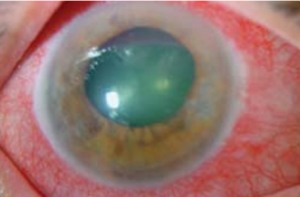
What is the most likely diagnosis for this presentation? (1)
- Acute Angle Closure Glaucoma
What are the differentials for this presentation? (6)
- Iritis
- Keratitis
- Herpes zoster Ophthalmicus
- Scleritis
- Optic neuritis
- Corneal disorder
- Endophthalmitis
- Anterior uveitis
- Corneal abrasion
- Conjunctivitis
- Foreign body
- Conjunctival hemorrhage
What are the KEY FEATURES OF HISTORY in acute angle closure glaucoma? (6)
- Severe ocular pain
- Frontal headache
- Vomiting
- Nausea
- Eye redness
- Blurring of vision
- Visual loss
- Coloured halos around lights
What are the KEY FEATURES OF EXAMINATION in acute angle closure glaucoma? (6)
- Patient generally unwell with intense eye pain
- Injected conjunctivae / red eye
- VA decreased
- Visual field loss
- Eye is rock hard to palpation
- IOP typically severely elevated > 50
- fixed semidilated pupil
- Non-reacting pupil
- Very high IOP
- Cloudy cornea
- Swollen cornea
- Shallow anterior chamber
- Pronounced cupping
- Pale central depression of optic disc
- Increased cup to disc ratio of > 0.6
What is a normal intraocular pressure? (1)
- 10-20 mmHg
What are the MOST IMPORTANT IMMEDATE MANAGEMENT steps in managing acute angle closure glaucoma? (3)
- Immediate referral to ophthalmologist
- IV or PO Acetazolamide 500mg
- Check IOP hourly
What are the risk factors for the primary form of acute angle closure glaucoma?
- shallow anterior chamber
- female
- age
- Asian ethnicity
- long sightedness (hyperopia)
- family history
- previous history
What are the secondary causes of acute angle closure glaucoma? (5)
- Anterior Uveitis
- Neovascular glaucom
- membranous obstruction, e.g. iridocorneal endothelial syndrome
- lens-induced, e.g. large lens or small eye
- drugs, e.g. topiramate and sulfonamides, SSRIs
- central retinal vein occlusion (CRVO)
- post-op/ laser treatment
- posterior segment tumour
- cataracts
- eye injuries
- SSRIs
- Dark room
Which classes of medications can precipitate acute angle closure glaucoma? (4)
- Topical vasodilators
- SSRIs
- Topimarate
- Sulfonamides
What medication should not be given if the IOP is > 40mmHg in acute angle closure glaucoma?
- Topical pilocarpine
What are the main categories/classes of medications used to treat acute angle closure glaucoma? (5)
- Beta blockers
- Postaglandin derivatives
- Alpha 2 adreneric agents
- Miotics
- Carbonic anhydrase inhibitors
What are the complications that can arise from acute angle closure glaucoma? (2)
- permanent loss of vision,
- repetition of the acute attack,
- attack in the fellow eye
- central retinal artery or vein occlusion.
Acute Angle Closure Glaucoma on Soundcloud
References
https://patient.info/doctor/primary-open-angle-glaucoma
http://www.racgp.org.au/afp/2014/july/eye-care-in-the-elderly/
http://www.australiandoctor.com.au/cmspages/getfile.aspx?guid=50b1dafb-83c8-4f2b-9006-2030c44c7cab
http://www.graduatemedicine.com/kb/a/1630/c/15722/acute-glaucoma
http://www.racgp.org.au/your-practice/guidelines/redbook/12-glaucoma/


